By Gregory Caronis, MD – Orthopedic Foot & Ankle Surgeon, Fellowship-Trained
The ankle anatomy is a marvel of biological engineering. This complex joint provides the necessary range of motion to move your foot up, down, and side-to-side, all while bearing the full weight of your body with every step.
The Skeletal Structure
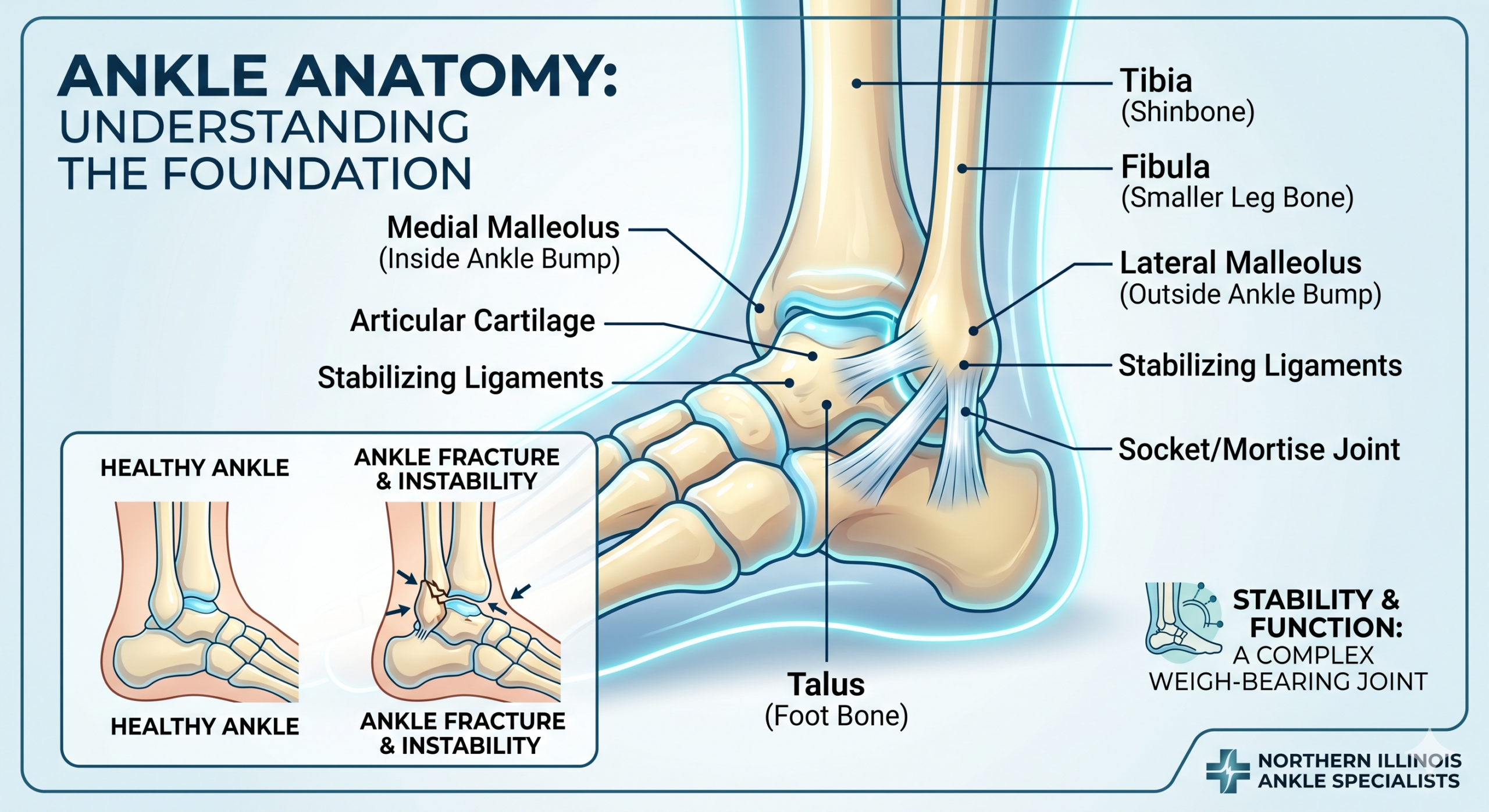
At its core, ankle anatomy consists of three primary bones that work in harmony:
-
The Tibia: Commonly known as the shinbone, it supports the majority of your weight.
-
The Fibula: The thinner bone running along the outside of the lower leg.
-
The Talus: A uniquely shaped bone in the foot that sits directly beneath the tibia.
These bones converge to form the ankle joint. The base of the tibia and fibula create the medial malleolus (the bump on the inside of your ankle) and the lateral malleolus (the bump on the outside). Together, they form a “mortise” or socket that secures the talus, ensuring stability during movement.
Stability and Function
The integrity of ankle anatomy relies on a network of high-strength ligaments that stabilize the joint on both the medial and lateral sides. Because the ankle must be simultaneously flexible and rigid enough to support your body weight, even a minor disruption can have significant consequences.
When a fracture occurs, the delicate balance of the ankle anatomy is compromised. Even a slight shift in bone alignment can:
-
Alter joint mechanics.
-
Increase wear and tear on cartilage.
-
Lead to chronic issues such as post-traumatic arthritis.
Key Insight: A deep understanding of ankle anatomy is what allows specialists to determine which fractures can heal naturally and which require surgical intervention to restore the joint’s precise alignment.
Why Choose Our Practice?
We prioritize a “diagnosis-first” philosophy. By focusing on the nuances of ankle anatomy, we identify subtle instabilities and alignment shifts that others might miss, ensuring your long-term mobility is protected.
Schedule a Consultation
If you’re experiencing heel or Achilles pain, don’t wait for it to worsen. Early diagnosis and treatment can make a significant difference in recovery.
Gregory Caronis, MD
Orthopedic Foot & Ankle Surgeon – Northern Illinois